Burnout Recovery: Why Rest Doesn’t Fix It And What Actually Does. If you’ve taken the holiday, slept the extra hours, tried the wellness practices, paid for the retreats, and you still feel flat, heavy, and disengaged from a business you used to love, you are not the problem. The diagnosis is.
After 25 years of working with women in burnout recovery, I often see a pattern few burnout resources mention: many high-functioning founders aren’t exhausted; they’re in a state of functional freeze. This freeze doesn’t improve with rest, and sometimes, resting can even exacerbate the situation.
This article about burnout recovery unpacks why and what to do instead.
The Two Burnouts (And Only One Responds to Rest)
When people use the word “burnout,” they are almost always referring to one of two distinct nervous system states. Both feel awful. Only one is genuinely fixed by rest.
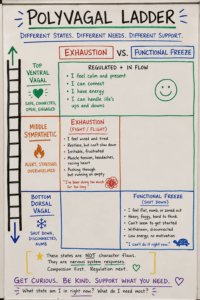
The initial stage is exhaustion, the burnout targeted by most wellness strategies. It results from sympathetic dominance, in which the fight-or-flight response remains active for too long. Signs include feeling wired, racing thoughts, difficulty relaxing, waking at 4 am, high cortisol levels, and a sense of endless energy without relief. Rest is the solution for exhaustion. Taking two days off, ensuring quality sleep, allows the system to reset. Even a holiday can be effective. This is the primary focus of most burnout recovery protocols.
The second stage is functional freeze, which occurs after prolonged sympathetic dominance causes the body to halt energy production as a protective measure. Neuroscientist Stephen Porges first formally described this shutdown in his 1995 Polyvagal Theory, with clinical refinement by Deb Dana via the polyvagal ladder. Dorsal vagal shutdown is now well-established in trauma-informed practice as a specific nervous system state, not merely exhaustion, but a different physiological response.
The dorsal vagal complex, part of your parasympathetic nervous system, triggers a shutdown response that reduces activity. Heart rate decreases, digestion slows, and mental clarity diminishes. To others, a founder in freeze may seem fully operational; she responds to emails, attends calls, and smiles in meetings. However, internally, she feels flat, heavy, and disconnected from her life. She often describes herself as “running on empty,” “going through the motions,” or “not feeling anything anymore.”
Freeze is not exhaustion. And freeze does not respond to rest.
Why Rest Makes Freeze Worse
This is the part most burnout content refuses to say, and it has cost women millions of pounds in failed recovery.
Freeze is a protective response. The nervous system perceives energy production as risky because previously produced energy was quickly used to meet additional demands. This shutdown acts as a safety mechanism rather than a failure of the body.
A 2022 study in Psychoneuroendocrinology found significantly higher allostatic load, the cumulative physiological burden of chronic stress, among adults meeting clinical burnout criteria, though the load varied markedly by burnout profile. The Regensburg Burnout Project found that exhaustion-dominant and depersonalisation-dominant profiles showed distinct physiological signatures, which is exactly why a single intervention cannot work for both.
When you respond to that protective shutdown with a week of nothing, no demands, no movement, no engagement, no input, your nervous system reads it as confirmation that producing energy is dangerous. The shutdown deepens. You return from the holiday feeling worse and blame yourself, even though the protocol itself was wrong.
I encounter this pattern nearly every week in my clinic: intelligent, capable women who have followed all the advice from the wellness industry but now feel more disconnected from themselves than ever. They quietly believe they must be the ones broken, but they are not. The problem lies with the protocol itself, which treats ‘freeze’ as exhaustion and ends up making it worse.
Exhaustion vs Functional Freeze: A Clinical Comparison
| Symptom | Exhaustion (Sympathetic Dominance) | Functional Freeze (Dorsal Vagal Shutdown) |
| Energy state | Wired, depleted, can’t switch off | Flat, heavy, can’t switch on |
| Mental state | Racing thoughts, intrusive worry, planning | Foggy, distant, “going through the motions” |
| Sleep | 4 am wakings, difficulty falling asleep | Sleeps long but wakes unrefreshed |
| Emotional tone | Anxious, irritable, on edge | Numb, detached, depersonalised |
| Heart rate | Elevated, variable | Low, dampened |
| Cortisol | Elevated (high allostatic load) | Often blunted or flattened |
| Response to rest | Genuine recovery within 2–7 days | Often deepens; recovery stalls or reverses |
| Response to pushing | Tips deeper into sympathetic activation | Briefly mobilises, then collapses back |
| Underlying mechanism | Allostatic overload, HPA axis dysregulation | Dorsal vagal protective shutdown (Porges, 2001) |
| Clinical protocol | Rest, sleep, stressor removal | Orient → activate → rest, in that order |
What Functional Freeze Actually Needs
Functional freeze responds reliably to one thing: gentle, titrated re-introduction of safe activation. You cannot rest your way out; rest deepens the shutdown. You also cannot push your way out; pushing tips the system back into sympathetic overdrive, and the cycle starts again. You have to move out, in small increments, in a specific order.
In clinical practice, the sequence is orient → activate → rest. The order is the entire point. Run it backwards, which is how most burnout advice runs it, and almost nothing happens.
This sequence is grounded in Porges’s neuroception model, his term for the subconscious scanning process through which the nervous system continuously assesses safety. Until the system has neuroceived safety, no other intervention will reliably take hold.
Step One — Orient Before You Regulate
Before attempting to change your nervous system state, it’s essential that your nervous system feels safe. Many regulation strategies skip this initial step, which can lead to failure in situations of freeze. Orienting is straightforward: slowly turn your head, scan the room, and verbally identify three specific objects. Do this for thirty seconds. This isn’t meditation; it’s an explicit signal to the dorsal vagal complex that the environment is being actively scanned and deemed safe. Often, in a deep freeze, this is the first time in months that your system has received such a reassurance.
Step Two — Add Small, Voluntary Activation
After orientation, your nervous system can handle a small amount of activation. Try two minutes of slow walking, splash cold water on your face, or hum for thirty seconds; these directly stimulate the vagus nerve and are valuable clinical tools. The correct dose is crucial; too much can trigger sympathetic overdrive, while too little keeps the system in freeze mode. About two minutes generally provides an effective dose.
Step Three — Then, And Only Then, Rest
After gentle activation and orientation, rest fulfils its function, allowing the system to metabolise it effectively. Most wellness advice incorrectly suggests resting first and then re-engaging, but in clinical practice, the reverse is true. By signalling safety and adding gentle activation, followed by rest, the process becomes truly restorative, possibly for the first time in a long period.
| GET THE FULL CLINICAL PROTOCOL: The orient–activate–rest sequence is the foundation. The full clinical work is mapping which of the 7 Stress Saboteurs is running underneath your freeze because the saboteur is what keeps tipping you back in. The Resilient Founder Reset Kit walks you through all 7 saboteurs, gives you the Three Costs Audit, and contains the full sequence. 37 pages. £19. Finish it tonight. → Get the Kit |
A Real Case: The £200,000 Burnout Recovery
A client I worked with last year, who remains anonymous but whose details are authentic, came to me after two years of struggling to recover from what she described as burnout. She took a six-month sabbatical and spent £18,000 on retreats, supplements, coaching, and somatic courses. She read every book on the subject and also lost about £200,000 in revenue from a business she no longer could operate. Additionally, she gained eleven kilograms due to a nervous system that had ceased to metabolise properly.
She wasn’t lazy, weak, or lacking discipline. She was experiencing a functional freeze due to exhaustion. All the interventions she attempted were appropriate for a wired, depleted nervous system in state one. However, hers was in state two. The interventions weren’t unsuccessful because of her; they were ineffective because they targeted the wrong condition.
Within nine weeks of implementing the orient–activate–rest sequence and our broader clinical work, during which we identified her primary saboteur pattern, worked on managing the cortisol cycle, and gradually rebuilt her capacity, she was back at the laptop. After four months, her revenue was already coming back. This progression is common; it’s what occurs when rest is no longer used as a fix for a problem that isn’t actually a nail.
Why The Wellness Industry Keeps Getting This Wrong
Most burnout advice is focused on exhaustion rather than freeze because exhaustion is more noticeable. It appears as dramatic tears, collapse, and the failure to continue, which create a compelling story and promote retreats.
Freeze remains unseen. It resembles a high-achieving founder who is silently disengaged from her own life. It doesn’t make for an attractive Instagram post or a compelling wellness retreat brochure. As a result, the industry has focused on the visible state, often overlooking the deeper, less obvious one.
This isn’t a moral failing on the industry’s part; rather, it’s a marketing issue. However, this has led to a generation of female founders who are taking the right actions for the wrong circumstances, often blaming themselves when nothing succeeds.
If you have been in this loop, resting and resting and feeling worse, or pushing harder and getting flatter, it is not you. It is the diagnosis. Change the diagnosis, and the recovery finally becomes possible.
What To Do This Week
Three honest questions to sit with this week:
- When you rest, do you wake up genuinely restored or just as flat?
- Is your mind racing (exhaustion) or is it heavy and disengaged (freeze)?
- How much money has freeze cost you this year in delayed launches, avoided sales conversations, and decisions you couldn’t make?
If your responses lead to freeze, the next step is to identify which saboteur pattern is active. Freeze rarely appears on its own; it often underlies a saboteur such as the Perfectionist, who keeps rewriting, the People-Pleaser, who struggles to maintain boundaries, or the Invisible One, who remains unseen. Usually, the saboteur is what drives the cycle’s reactivation.
Frequently Asked Questions About Burnout Recovery
Why doesn’t rest help my burnout?
Rest addresses only one form of burnout, what I call exhaustion from sympathetic dominance. When you are in a functional freeze, your nervous system is in a protective shutdown, seeing extended rest as evidence that generating energy is risky. Instead of relieving the shutdown, rest can make it worse. To move forward, you first need to signal safety to your nervous system, then gradually introduce small, voluntary activations, and only afterwards can you rest effectively.
How do I know if I’m in functional freeze or exhaustion?
The main difference is energy direction. Exhaustion is like having too much energy with no way to release it, feeling wired, restless, and unable to relax. Functional freeze, on the other hand, is like having too little energy with no way to boost it, feeling dull, heavy, and unable to activate. If you sleep long but wake unrefreshed, or if your mind is foggy instead of racing, and you feel detached from things you once cared about, you’re probably experiencing freeze rather than exhaustion.
Can a functional freeze be reversed?
Yes. Functional freeze is a temporary state, not a permanent one. In clinical practice, the orient–activate–rest sequence effectively initiates change within days when used properly. Complete recovery, characterised by stable ventral vagal regulation and restored executive functions, usually requires 9 to 16 weeks of structured therapy, depending on the duration of the freeze and the behavioural patterns that trigger it.
Is functional freeze the same as depression?
While they share similar surface symptoms such as low mood, low energy, flat affect, and anhedonia, they differ. Functional freeze is an autonomic nervous system shutdown response controlled by the dorsal vagal complex. Depression involves neurochemical imbalances, including serotonin and dopamine dysregulation. These conditions can coexist, and a freeze can sometimes appear clinically as depression. If you’ve been diagnosed with depression and standard treatments haven’t helped, an underlying freeze might have been overlooked.
How long does burnout recovery take for women?
This varies based on the individual’s state. Exhaustion-type burnout generally improves after 2 to 6 weeks of genuine rest and reduced stress. In contrast, a functional freeze usually requires a longer period, often 9 to 16 weeks of structured clinical work, as the system needs to relearn that generating energy is safe. Rushing either process can prevent progress and may even worsen the freeze.
What is the dorsal vagal complex?
The dorsal vagal complex is the ancient, more basic part of the vagus nerve, controlling the deepest layer of the parasympathetic nervous system. When triggered as a protective measure, it induces shutdown, lowering heart rate, reducing digestion, and conserving energy. Stephen Porges introduced its role in Polyvagal Theory in 1995. This state of the nervous system is most often overlooked during burnout recovery.
Does humming really stimulate the vagus nerve?
Yes. Humming creates vibrations in the laryngeal and pharyngeal muscles, which are controlled by the vagus nerve. Holding the hum steady for 30 to 60 seconds can boost heart rate variability, an indicator of vagal tone, and softly stimulates the ventral vagal branch, which supports social engagement and a calm focus. It is a highly effective yet often underutilised clinical technique to transition out of dorsal vagal shutdown.
Why do I feel worse after a holiday?
If you feel worse after a holiday instead of refreshed, you’re likely experiencing a functional freeze rather than exhaustion. A week of rest confirms to a frozen nervous system that producing energy is risky, so it continues to conserve. This results in a deeper shutdown. This is not a failure of your holiday or willpower but an indicator that the current protocol is unsuitable for your needs.
What are the 9 Stress Saboteurs?
The 9 Stress Saboteurs are conditioned behavioural patterns that overlay nervous system dysregulation and repeatedly trigger it. They include the Perfectionist, People-Pleaser, Invisible One, Achiever, and three others. These are not personality types but loops developed by the nervous system to handle chronic threat. Recognising your main saboteur is crucial to preventing your recovery from collapsing back into freeze every two weeks.
Can CBT help with burnout?
CBT is highly effective in addressing the cognitive aspects of burnout, such as perfectionism, catastrophizing, and the “I should be coping better” cycles. However, on its own, it is less effective for the physiological aspect, especially functional freeze, because this is controlled by the autonomic nervous system beneath conscious thought. The most successful clinical strategy combines CBT targeting these cognitive patterns with somatic and polyvagal-informed techniques to address the underlying state of the nervous system.
What’s the difference between burnout and being tired?
Tiredness is a temporary condition that improves with a good night’s sleep or a relaxing weekend. In contrast, burnout, as defined by Christina Maslach’s clinical criteria, is a prolonged syndrome characterised by three key aspects: emotional exhaustion, depersonalisation, and a diminished sense of personal achievement. Burnout also has identifiable physiological signs, such as increased allostatic load, and does not get better with normal rest. If your fatigue persists beyond six weeks and rest doesn’t help, it’s likely not just tiredness.
Where should I start if I think I’m in a functional freeze?
Begin with the orient step by slowly turning your head and scanning your environment. Name three objects out loud. Do this for 30 seconds, 2 or 3 times today. While this won’t cure freeze, it helps your nervous system experience explicit safety, which is the foundation for everything else. From there, the Resilient Founder Reset Kit guides you through the complete clinical sequence and saboteur mapping.
Your Next Step
The Resilient Founder Reset Kit is a 37-page clinical guide that maps all 7 Stress Saboteurs, walks you through the orient–activate–rest sequence in detail, and contains the Three Costs Audit you can run on yourself tonight. It is £19. You will finish it in one sitting. You will know exactly which pattern has been costing you the most and what to do about it.
| → Get the Resilient Founder Reset Kit · £19 37 pages. 7 Saboteur profiles. 3 clinical tools. The Three Costs Audit. The full orient–activate–rest sequence. One to One The Inner CEO Rewire available – Book here. |
About The Author
Andrea A. Smith is a Clinical Therapist, CBT Practitioner, and Clinical Hypnotherapist with 25 years of clinical experience. She specialises in nervous system regulation for high-performing women and female founders, and is the creator of the ACE™ and RESET™ methods. She publishes The Clinical Reset Series on YouTube and writes for female founders on LinkedIn.